Synergistic Potential of a Molecularly Structured Protein Matrix (MSPM)and Auditory Neuromodulation in Metabolic Regulation: A Theoretical Perspective
Volodymyr Naumenko
Founder & CEO, Patented MT Company (Vilnius, Lithuania)
Academician of the Ukrainian Technological Academy
Department of Modern Medical Technologies and Ecology
ORCID: 0009-0000-3965-5205
This material is published in the CERN-hosted repository (DOI: 10.5281/zenodo.19534062).
Abstract: To address the complex challenges of biological aging, a multimodal framework is proposed, integrating a Molecularly Structured Protein Matrix.
(MSPM)derived from Saccharomyces spp. with a structured auditory neuromodulation protocol. This system leverages genetic homology (~11% orthologous genes) between Saccharomyces and Homo sapiens to target conserved eukaryotic metabolic pathways, specifically NAD+ biosynthesis and mitochondrial function. The MSPM has been analytically validated at Kaunas University of Technology to ensure reproducibility and structural integrity. Complementing the biochemical component, the auditory axis is designed to influence autonomic balance through structured neurophysiological modulation. This perspective presents the mechanistic rationale for the MSPM framework, supported by preliminary analytical data, and aims to provide a robust foundation for upcoming controlled human clinical trials. The authors welcome collaboration with academic institutions and strategic partners to advance the clinical validation phase.
1. Introduction
Biological aging is characterized by a progressive decline in metabolic efficiency, mitochondrial dysfunction, and an imbalance in the autonomic nervous system (ANS). Current interventions often address these factors in isolation. This paper introduces a multimodal approach based on a Molecularly Structured Protein
Matrix (MSPM) and neuroacoustic stimulation to provide a comprehensive regulatory effect on the aging organism.
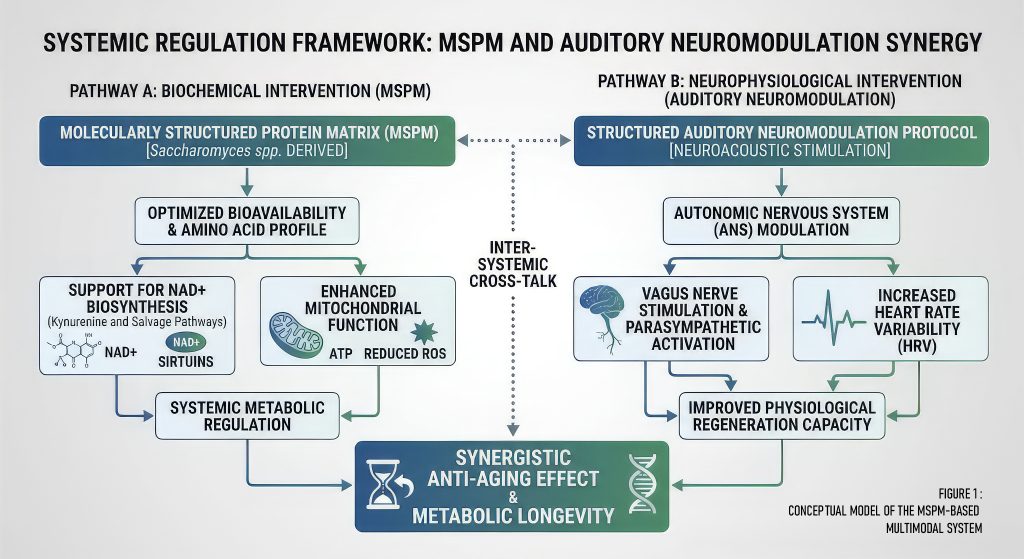
Figure 1: Conceptual model of the MSPM framework integration, detailing the biochemical (left) and neurophysiological (right) pathways for synergistic metabolic regulation.
The MSPM Technology: Biochemical Rationale
The core of the metabolic component is the MSPM, a fungal-derived protein matrix produced through a specific technological process that modifies the physical structure of protein globules into a filamentous form.
• Bioavailability: This structural modification is hypothesized to enhance metabolic assimilation and provide a highly bioavailable pool of essential amino acids.
• NAD+ Support: Given the genetic homology between Saccharomyces and humans, the MSPM is designed to support the kynurenine pathway and salvage pathways for NAD+ synthesis, which are critical for mitochondrial bioenergetics.
• Validation: The qualitative and quantitative amino acid profile of the MSPM has been technically validated by Kaunas University of Technology (KTU), confirming its suitability for high-level metabolic support.
Auditory Neuromodulation and ANS Balance
In synergy with the biochemical matrix, the framework utilizes a specific auditory protocol. This neurophysiological axis targets the autonomic nervous system, aiming to improve Heart Rate Variability (HRV) and shift the balance from sympathetic dominance (stress) toward parasympathetic activity (regeneration).
Regulatory Compliance and Safety
The technology described herein is implemented within a standardized manufacturing framework in the European Union. The production process and safety profile are compliant with EU regulatory requirements (VMVT approval No. 46-18, Lithuania), ensuring the quality and safety of the MSPM for its intended applications in metabolic management.
Conclusion
The integration of MSPM technology with auditory neuromodulation offers a novel, non-invasive strategy for managing the metabolic and physiological markers of aging. By optimizing nitrogen balance and autonomic regulation, this framework provides a scalable model for regenerative health.
References (Full Format Recommended)
- López-Otín C, Blasco MA, Partridge L, Serrano M, Kroemer G. The hallmarks of aging. Cell. 2013;153(6):1194-1217. doi:10.1016 /j.
cell.2013.05.039. - Cantó C, Menzies KJ, Auwerx J. NAD+ Metabolism and the Control of Energy Homeostasis: A Balancing Act between Mitochondria and the Nucleus. Endocr Rev. 2015;36(6):635-666. doi:10.1210/er.2015-1082.
- Shaffer F, Ginsberg JP. An Overview of Heart Rate Variability Metrics and Norms. Front Public Health. 2017; 5:258. doi:10.3389/fpubh.2017.00258.
- Thayer JF, Ahs F, Fredrikson M, Sollers JJ 3rd, Wager TD. A meta-analysis of heart rate variability and neuroimaging studies: implications for heart rate variability as a marker of cortical-subcortical interactions. Neurosci Biobehav Rev. 2012;36(2):747-756.
This framework is based on a systems-level interpretation of biological ageing as a loss of coordinated regulation between metabolic and neurophysiological processes.
At the cellular level, ageing is strongly associated with impaired mitochondrial bioenergetics, reduced NAD⁺ availability, and disruptions in proteostasis. These processes are not independent; they are dynamically regulated within a broader physiological network. The use of a Saccharomyces-derived matrix is grounded in the evolutionary conservation of core eukaryotic metabolic pathways, suggesting that structurally preserved biochemical inputs may interact with human cellular systems at the level of fundamental metabolic regulation.
However, cellular metabolism does not operate in isolation. It is continuously modulated by higher-order regulatory systems, particularly the autonomic nervous system. Neurophysiological control influences mitochondrial function, redox balance, and systemic energy distribution through established signalling pathways.
Within this context, the auditory neuromodulation component can be understood as a method for structured external modulation of autonomic dynamics. Frequency-patterned acoustic stimulation has been shown to affect parasympathetic activity, heart rate variability (HRV), and neural oscillatory states — all of which are directly associated with systemic adaptability and resilience.
The central premise of this approach lies in the interaction between these two domains. The biochemical axis provides substrate-level support for cellular processes, while the neuromodulatory axis influences the regulatory architecture that governs these processes. This creates a coupled system in which metabolic capacity and regulatory control are addressed simultaneously.
From a systems biology perspective, such coupling is critical. Biological ageing is not defined by the failure of a single pathway, but by the progressive loss of synchronisation across multiple layers of organisation. Therefore, interventions that operate on only one level are inherently limited.
The proposed dual-axis model introduces a coordinated strategy aimed at restoring functional coherence between cellular metabolism and systemic regulation. In this sense, the framework does not target ageing as a static condition, but rather as a dynamic process of declining adaptability.
Testable Implications and Experimental Direction
If the proposed model is valid, it should produce measurable effects across both metabolic and regulatory domains, as well as in their interaction.
At the biochemical level, expected outcomes include:
• increased NAD⁺ availability or improved NAD⁺/NADH ratio
• enhanced mitochondrial efficiency (e.g. ATP production, oxygen utilisation)
• stabilisation of amino acid utilisation profiles and proteostatic balance
At the neurophysiological level, measurable effects should include:
• increased parasympathetic activity
• improvements in heart rate variability (HRV) metrics
• more stable neural oscillatory patterns associated with adaptive regulation
Critically, the defining feature of this framework is not isolated effects, but cross-domain coupling. Therefore, experimental validation should specifically test:
• whether changes in HRV correlate with improvements in metabolic markers
• whether combined intervention produces effects greater than the sum of individual components
• whether the system demonstrates increased resilience under physiological stress conditions
A rigorous validation strategy would require:
• controlled studies with separate and combined intervention arms (biochemical vs neuromodulatory vs integrated)
• time-resolved measurements to assess dynamic adaptation rather than static endpoints
• reproducible protocols for both the molecular matrix and the auditory stimulation parameters
Such an approach would allow differentiation between simple additive effects and true systemic integration.
Conclusion
Although the proposed framework is scientifically grounded and built upon established physiological principles, further controlled investigation is required to quantify its effects and define its operational parameters.
Importantly, the value of this approach lies not only in its conceptual coherence, but in its capacity to be systematically tested across both metabolic and neurophysiological domains. This positions the framework as a viable foundation for the development of integrative, system-level interventions in biological ageing.
Keywords:
Biological ageing; systems biology; mitochondrial bioenergetics; NAD⁺ metabolism; autonomic nervous system; heart rate variability; neuromodulation; dual-axis model; systemic adaptability; integrative physiology.
Indexing / Search Terms
systems biology of biological ageing; integrative regulation of biological ageing; autonomic nervous system and mitochondrial function; NAD+ metabolism and cellular energy regulation; heart rate variability and physiological adaptation; neuromodulation and autonomic regulation; auditory neuromodulation and systemic regulation; metabolic and neurophysiological coupling; multi-level regulation of biological systems; integrative interventions in ageing research